


CRREM introduces a new dimension to the real estate sector, particularly for investors, asset managers, and fund managers, thanks to the tool's multi-functional capabilities, which:
This Excel-based tool is available free of charge (https://www.crrem.eu/tool/) and is user-friendly.
CRREM has a very simple functionality: to produce, without requiring user data input, a graph and a table of values for the 2018-2050 decarbonization trajectory (-1.5°C or -2°C) for a country and for a building typology. The values are provided in carbon intensity (kgCO2e/m²/year).
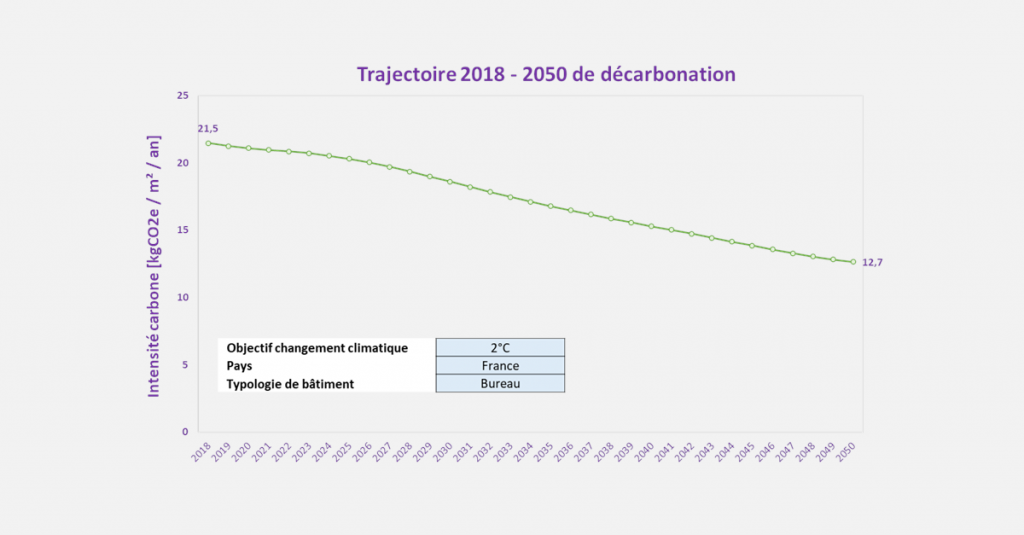
Example of a 2°C carbon trajectory (Country: France; Typology: Office)
Users have the ability to study their trajectories for all European Union countries and for a multitude of typologies: office, retail, warehouse, logistics, distribution, hotel, hospital, residential, leisure, data center.
To produce decarbonization trajectories, CRREM employs a downscaling process comprising 3 steps:

The three steps for defining typical decarbonization pathways
The principle remains the same: how does the current trajectory of the studied building compare to the reference decarbonization trajectory? Is it below or above?
If the studied trajectory is above the reference trajectory, it implies that the asset is facing not only environmental but also economic obsolescence. Indeed, such an asset would be increasingly exposed to the risk of economic obsolescence due to climate change, as it would fail to meet future regulatory efficiency standards or market expectations. It would become less marketable and require costly renovation measures.
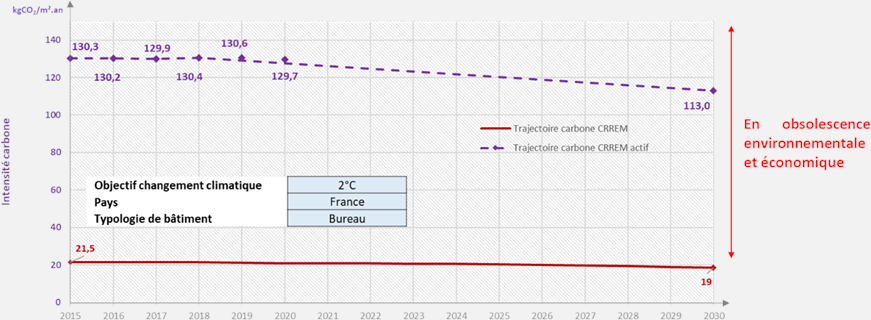
Example of a French office building's positioning relative to the reference decarbonization pathway
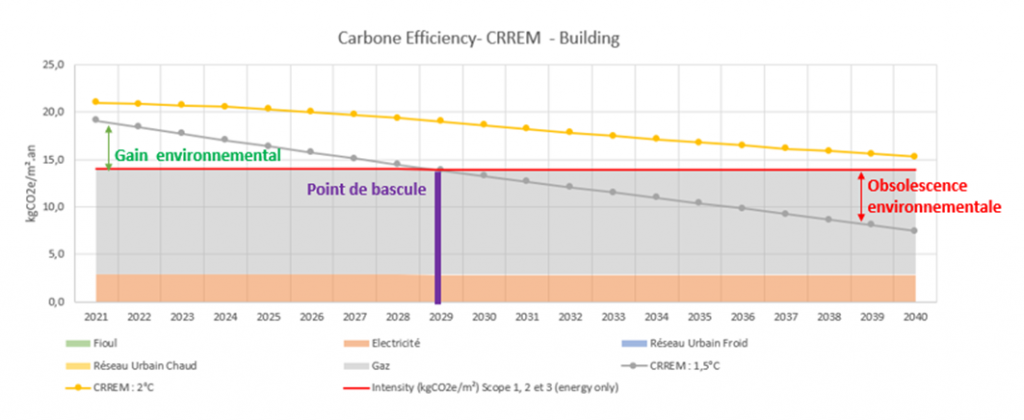
Example of a building entering obsolescence in 2029 relative to the CRREM 1.5°C trajectory
Thus, the projection of carbon emissions highlights the building's obsolescence starting from 2029. Leveraging our expertise acquired since 2008 across over 25 million m² of building areas, our work involves quantifying energy savings and avoided emissions associated with each action or work scenario.
Once this list of energy and environmental actions is defined for each asset, we can phase the work on each operational building. Beyond the environmental aspect, several factors allow us to phase these works:
Thus, referring back to our previous example, we sought to model and then phase the works as follows:
This provides the following graphical example:
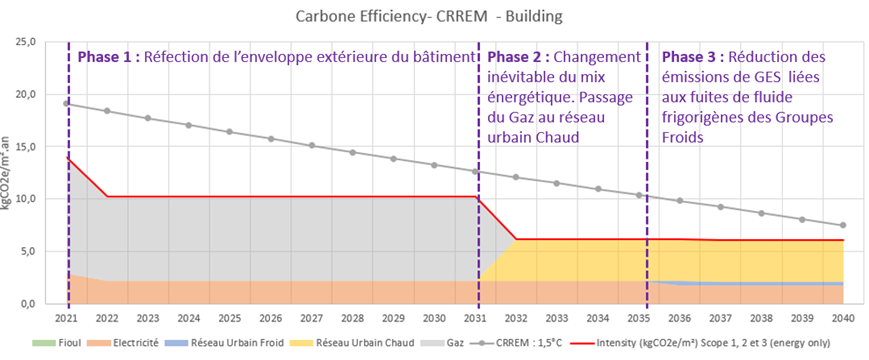
Example of a building with an anticipated carbon trajectory
Consequently, our expertise enables the Asset Manager to quantify these actions financially, energetically, and environmentally, assisting them in developing their short, medium, and long-term strategy.
At the portfolio level, we compile data from all buildings within the scope and then annually disseminate the achievement of the CRREM objective.
This information allows for the comparison of two real estate portfolios across several scales:
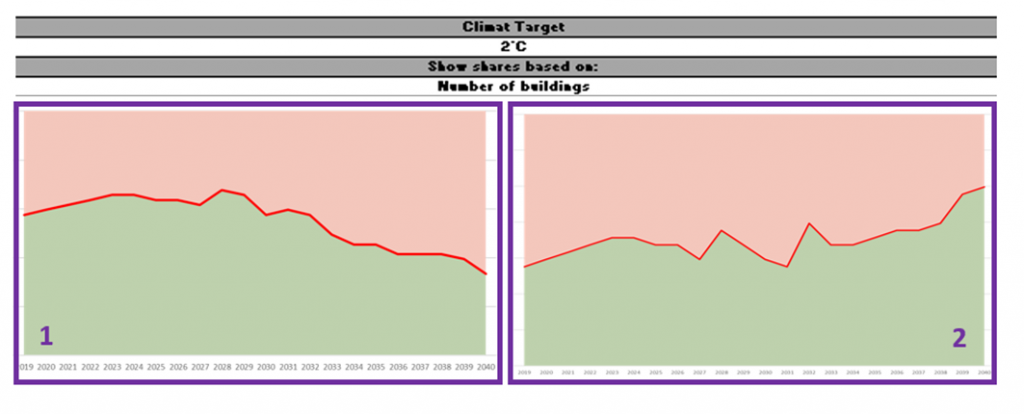
The green section represents assets complying with the climate target; from the example above, we can deduce that:
In this manner, a combined top-down and bottom-up strategy can be implemented between the Investor and the Asset Manager to reassess the environmental performance of certain assets.
Allianz Real Estate, a member of the UN-Convened Net-Zero Asset Owner Alliance, aims for carbon neutrality by 2050. Sinteo has supported us for over 5 years in implementing this strategy concerning environmental aspects with our tenants. By notably organizing environmental committees with them, Sinteo facilitates discussions on energy consumption and environmental actions. Three years ago, we took an additional step by adopting a building-centric approach in anticipation of what was then the future Tertiary Decree. Finally, this year we are complementing our actions within a long-term environmental strategy for all our real estate assets, specifically to anticipate the climate obsolescence of our buildings. Indeed, the renovation decisions made today will have an impact for decades, making it crucial for all of us to be aware of these major issues. Furthermore, our portfolio of "Prime" buildings includes Haussmannian properties with a rich history but not always suited to a low-carbon strategy. We have therefore defined a package of energy actions for each asset based on its specificity, managed by the Asset Manager, which allows us, through graphical representation, to directly monitor the impact of our decisions. Lastly, we can also engage with our Investors regarding the current state of their portfolio and jointly project its climate obsolescence.
Grigor Hadjiev and Sonia Benameur