
Contents 📖
After eighteen months of relative calm, energy costs are once again becoming a budget line item that must be balanced—for both landlords and the companies occupying their spaces. Renegotiating your contract will no longer be enough. That leaves operational savings—the core of energy management in commercial buildings—which require no investment, take effect as early as this winter, and to which we are committed: if they do not cover the cost of our services, we will not bill you.
IN BRIEF
- Gas prices have more than doubled since February, Brent crude has surpassed $100, and European gas inventories are heading into winter 15 points below their average. The 2027 natural gas futures contract has risen 26% in one month.
- Given the current economic climate, a structural threshold has been crossed: the end of the ARENH and TURPE programs, and an increase in excise taxes. The base amount of the 2027 bill will remain higher than that of 2025, regardless of how the crisis plays out.
- The only way to reduce this winter’s energy bill is through operational optimization: adjusting controls and eliminating energy waste—all without any investment.
- This resource is often the most significant in newer, sophisticated buildings.
- First, we verify that the deposit exists and that it justifies the assignment. Then we make a commitment: if the savings do not cover our fees, we do not bill for them.
Since the spring of 2025, those responsible for energy bills—both property owners and tenant companies—had grown accustomed to receiving good news every six months. Prices were falling, energy budgets were holding steady, and the issue was slipping down the priority list. That streak is over.
/ What the Markets Are Saying /
Data as of [September 24, 2026].
The trigger is geopolitical. Oil flows through the Strait of Hormuz have fallen to about 6 million barrels per day, or roughly 30% of pre-conflict levels. The result is therefore inevitable: the price of a barrel of Brent stood at $103.30 at the close of trading on September 18, 2026, compared with just over $70 at the start of the year.
Gas is next, and it will be the main factor affecting commercial buildings this winter. European gas storage levels stand at 70 percent, compared with 82 percent during the same period last year, and an average of 85 percent over the past five years . German gas storage levels are at their lowest in fifteen years, at 53 percent capacity . France is in a better position, but the market is interconnected: any strain across the Rhine is reflected in French energy bills.
Prices have already reacted. The European benchmark has surpassed 73 €/MWh, a level more than twice that of late February 2026. And for businesses, the impact is immediately reflected in their contracts. For example, the “Year 2027” contract—the benchmark for indexed commercial offers—is trading at 58.65 €/MWh, compared to 46.56 €/MWh a month earlier. The October rate schedule published by the CRE shows an 8% increase compared to September.
On the electricity front, the trend is less pronounced but points in the same direction. The regulated rate increased by an average of 2.5% (including tax) as of August 1, 2026, ending eighteen months of stability. Similarly, the non-residential “Tarif Bleu” rate has risen by an average of nearly 3% (excluding tax) since August.

/ The point that few stakeholders have grasped /
All of the above could come to an end. If tensions in the Middle East ease and we have a mild winter, prices would fall again.
Except that, given the current economic climate, a threshold has been crossed, and there’s no turning back. The ARENH (the mechanism that gave suppliers access to historic nuclear electricity at a regulated price of42 €/MWh) ended on December 31, 2025. Consumers are now fully exposed to wholesale prices. Furthermore, the new system, the Universal Nuclear Payment, targets an average price of approximately 70 €/MWh over fifteen years—well above the ARENH’s 42 €/MWh.
Add to it
- the annual review of the TURPE (the transmission tariff, which covers the costs of transmission and distribution on public electricity grids),
- the increase in the excise tax (formerly known as the TICFE, the government tax on electricity consumption),
- the reinstatement of the excise tax (formerly known as the TICFE, the government tax on electricity consumption)
And the baseline for your 2027 bill is structurally higher than that of 2025.
In fact, analysts no longer expect a quick return to normal. For example, HSBC raised its 2026 Brent forecast from $80 to $90 per barrel and its 2027 projection from $65 to $85. The bank estimates that the markets are unlikely to return to equilibrium before mid-2027 .
In other words: this isn't a crisis we're waiting to end. It's a whole new level.
/ The remaining lever: the energy you don't use /
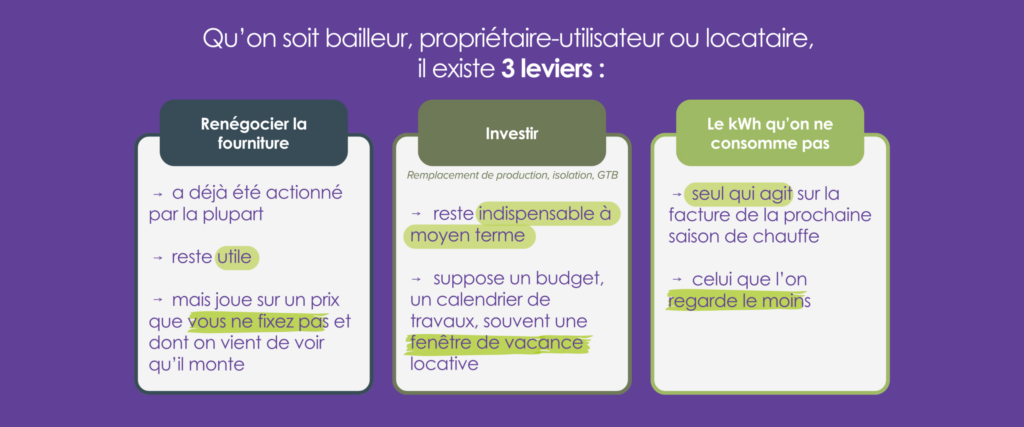
/ What Energy Management Really Aims to Achieve in a Commercial Building /
Energy management for a commercial building does not involve conducting a new study. For most buildings, audits already exist, and some of the measures have already been documented. Our first instinct, therefore, is to build on what has already been done, rather than repeat what has already been done.
But we rarely stop there. An audit describes a building at a given moment in time, often based on available documents and a single site visit. However, it does not reveal what the system actually does on a day-to-day basis, several years later, after changes in occupancy, maintenance work, and successive adjustments to its settings. This is where our hands-on experience comes into play: most of the issues we identify do not appear in any previous reports. They are uncovered by comparing load curves with the parameters actually applied in the building management system, and by going to the mechanical room to see what is running, how, and at what setpoints.
The situations we encounter are too varied to be reduced to a single category. However, two types often recur.
The first category involves standard operational settings: schedules that don’t match actual occupancy patterns, hot water tanks kept at a constant temperature all summer long, air-handling units that run at night and on weekends, and parking lot lights that stay on constantly. These are the most obvious examples, yet they rarely account for the bulk of the energy savings potential.
The second is less obvious, and that is often where the key lies: energy waste. The building consumes energy to produce heat and cooling that cancel each other out, or that are produced without being put to good use. Here are a few of the most common examples:
Overlap between hot and cold.
Inappropriate air outlet temperature.
Desynchronization between the CTA and terminal units.
Excessive fresh air supply rate.
Circulators and Distribution.
Idle Energy Recovery.
This list is by no means exhaustive, and that is precisely the point. Indeed, every building has its own history, its own operational trade-offs, and its own compromises in terms of comfort stemming from past demands. In other words, the real levers for change cannot be deduced from a catalog—they must be found on site.
Why Do Newer Buildings Drift the Most?
Contrary to popular belief, this potential has nothing to do with the age of the building. In fact, it is often the case that a newer building—one that is highly automated, equipped with a comprehensive building management system, and featuring sophisticated control sequences—holds greater potential for savings without investment than a building from the 1980s. The reason is simple: the more control loops, setpoints, operating modes, and interlocking sequences a system has, the more opportunities there are for deviations, and the more likely it is that the gap between theoretical operation—as described in the as-built documentation—and actual operation has widened. A simple building rarely goes out of regulation because it has few controls. Conversely, a complex building can go out of regulation without any warning, and its performance as stated on paper can long mask its actual energy consumption.
These situations do not appear on an invoice or in an energy consumption dashboard. Instead, they can be identified by cross-referencing load curves with actual BMS parameters and what is observed in the mechanical room. This is precisely the job of an energy manager, and it is what distinguishes energy consumption monitoring from operational optimization.
A real-life case: three audits, nine years, the same issues
And these aren’t just assumptions. We audited the same Parisian office building in 2016, 2020, and then 2025. During each audit, we identified the same issues with control systems and programming. Nine years, three identical findings, and no investment involved. It was simply that no one was tasked with monitoring the situation between these one-off assignments.
This, then, is precisely the role that energy management plays in commercial buildings: to ensure ongoing attention to details that neither the facility operator, nor the property manager, nor the asset manager has the time to handle on their own.
/ Why Do We Check Before We Commit? /
Not every situation is suitable for this, and we prefer to make that clear before billing for an assignment.
Before initiating a support program, we assess the appropriateness of the approach on a site-by-site basis, focusing on two simple questions.
Is there a resource that can be tapped without investment?
The criterion is not the age or level of equipment in the building, but rather when the optimization work was last performed: a facility whose control sequences have already been updated recently, or that is subject to ongoing operational monitoring, may offer only residual potential.
Do the size of the site and its energy consumption justify monitoring?
A 1,800-square-meter building with an annual utility bill of around €60,000 does not require the same level of management as a 30,000-square-meter property.
Added to this is a question of feasibility: the quality of the available meter reading data, the presence of usable technical management systems, and, above all, the actual ability to see actions through to completion, since we do not carry out any of the work ourselves. Each action is carried out by an operator, a maintenance provider, or an occupant. Thus, a problem located in common areas of a multi-tenant building is less likely to be resolved than an adjustment made in a mechanical room.
This preliminary analysis is also brief and inexpensive. Above all, it prevents us from undertaking a project that would not be cost-effective.
/Energy Management in the Commercial Sector: A Paying-for-Itself Initiative /
When the analysis yields a favorable outcome, we commit to the result: the savings generated at the site must cover the cost of the project. If this is not the case, we do not bill the full amount of our fees. The terms are determined on a case-by-case basis, site by site, following mutual validation of a baseline and a measurement and verification plan in accordance with the IPMVP protocol.
On the other hand, we do not ask for any bonus if the target is exceeded. We bear the risk; you reap the rewards. This decision is not an act of generosity: it ensures that our recommendations are focused on reducing your bill, not on increasing our compensation.
Depending on whether you are a landlord, an owner-occupier, or a tenant, the situation is different. For a business that occupies its own premises, the savings are reflected directly in its income statement, without being treated as an expense. For a landlord, the rationale is as much about asset management as it is about budgeting: controlled expenses upon re-leasing, asset value, and reduced renovation costs. In both cases, the process begins with the same technical assessment and follows the same method.
/ Energy management and the commercial building regulation—how do they fit into all this? /
One last point—and it's an important one.
In fact, every kWh saved through operations is a kWh that won’t need to be saved through investment. Energy management measures implemented in a commercial building under this framework directly count toward your Eco-Energy Commercial building trajectory and accordingly reduce the scope of the renovation efforts planned for 2030.
That’s what makes this type of project unique: it’s justified primarily by the budget, and it also ensures compliance. You’re not spending money just to meet a deadline. You’re reducing a burden while making progress on the regulation at the same time.