According to the Ministry of Ecological and Solidary Transition, land artificialization corresponds to "any surface removed from its natural, agricultural, or forest state, whether built or not, and whether paved or not." This term therefore refers to a change in land use, meaning a shift in its economic and social functions, from a natural or agricultural surface to an urbanized surface.
This imprecise definition leads to considering an urban green space and a built surface in the same way. This is why ecology professionals complement it by including both soil quality (structure, composition, biological activities, etc.) and habitat quality (species richness, vegetation stratification, ecological functionality, etc.), considering as artificialized "environments degraded, damaged, or destroyed by human activity." Therefore, there is not just one single form of artificialization, but rather several artificialization processes, with varying degrees of impermeabilization and different impacts.
Land artificialization is a major issue for public debate and political concern, especially in France. Indeed, in October 2015, land artificialization was integrated into the 10 new wealth indicators established by the Government to monitor its public policies. The following year, in August 2016, the law for the reconquest of biodiversity, nature, and landscapes was adopted, aiming to avoid, reduce, and compensate (ERC sequence) for the negative impacts of human activities on the environment. It was in 2018, within the Government's Biodiversity Plan, that the objective of " Zero Net Artificialization " (ZNA) by 2030 was unveiled, aiming to curb land artificialization and biodiversity erosion. A 70% reduction in gross artificialization and the renaturation of over 5,000 hectares would then be necessary to meet the ZNA target.
France Stratégie, following a joint request from the ministries responsible for Ecology, Territorial Cohesion, and Urban Planning, was tasked with drafting a report to clarify the challenges of this objective and propose levers for soil protection. Interministerial and partnership working groups, numerous representatives of spatial planning, NGOs (such as the LPO), and the Citizens' Convention for Climate have also proposed solutions to move towards land sobriety.
Upon its release, the ZNA was the subject of numerous debates and criticisms, including the imprecision of the definition of land artificialization, the absence of quantified objectives, and the term "net" which suggests compensation goals rather than the elimination of impacts.
To avoid focusing the ZNA solely on a restrictive approach, the proposed solutions must be multidisciplinary, multi-stakeholder, and realistic. Key levers include:
In France, the increase in artificialized territories is estimated at between 16,000 and 61,000 hectares per year. This discrepancy is explained by different analysis methodologies, both in terms of spatial resolution and the nomenclature of lands counted as artificialized.
In addition to having a higher average artificialization rate than its European neighbors, France also experiences a faster growth in artificialized land than its population. According to Teruti-Luca data (annual field survey), artificialized land increased from 3 million hectares in 1980 to 5.1 million today, representing a 70% growth, compared to 19% for the population during the same period (France Stratégie, 2019).
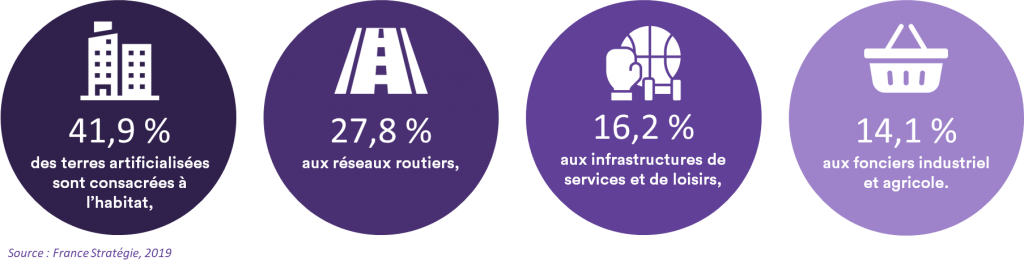
The growth dynamic of land artificialization is very unevenly distributed across the national territory, primarily concentrating in metropolitan areas and coastal zones. High demand for individual housing and the expansion of road networks are the two main drivers of soil sealing.
The IPBES (The Intergovernmental Science-Policy Platform on Biodiversity and Ecosystem Services), the biodiversity equivalent of the IPCC, estimates that 1 million animal and plant species are threatened with extinction due to net habitat loss. France, a true European maritime and terrestrial crossroads, is home to approximately 10% of global biodiversity. The General Commission for Sustainable Development (CGDD), the French Office for Biodiversity (OFB), and the National Biodiversity Observatory (ONB) estimate that 26% of these species are threatened with extinction or already extinct due to land artificialization.
The destruction and fragmentation of natural habitats and ecological corridors through urban sprawl (expansion on city outskirts) and scattered development (isolated construction in rural areas) are the primary causes of this biodiversity loss. This disrupts species' life cycles, impacting their feeding, migration, and reproduction.
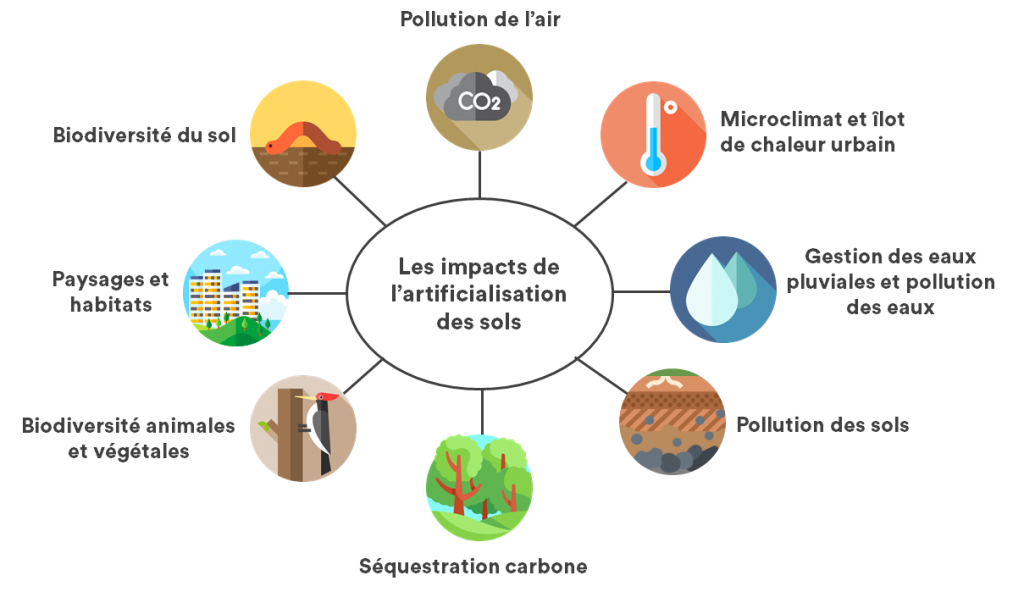
Artificialized soil refers to soil where the capacity to support local biodiversity is restricted, and where the quality and quantity of ecosystem services provided by natural soil are no longer guaranteed (e.g., carbon sequestration, air quality regulation, water infiltration, pollination).
The 6th mass extinction of biodiversity and climate change are undeniable realities. A consequence of uncontrolled human activity on Earth, this environmental crisis, in which humanity is now embroiled, compels us to rethink the functioning of all our systems, thereby revolutionizing modes of thought and development.
Artificialized soils are both the result and the living environment of human beings and their activities. Real estate, a sector with significant stakes, is therefore a key lever for change. Sinteo strives for post-carbon real estate: doing more with less, by increasingly focusing on renovation or new construction projects on already artificialized sites.
Beyond the current health context, the ZAN (Zero Net Artificialization) objective remains prominent, prompting us to pay closer attention to unsealed ground areas, which offer solutions to many current and future challenges we face. The goal is to act, together, towards urban regeneration, ecological restoration, and energy renovation.